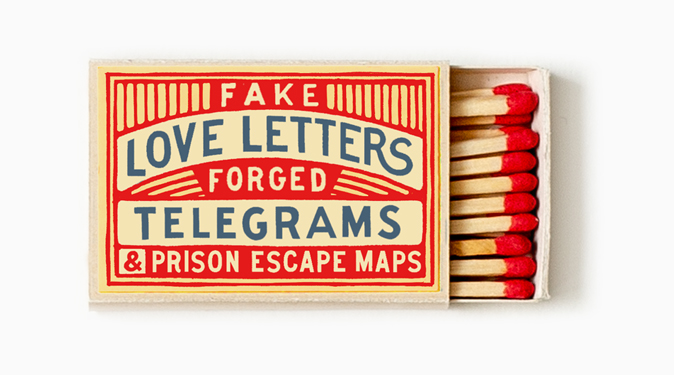


I make paper props that help bring imaginary worlds to life. Old newspapers, treasure maps, top secret documents… as well as the piles of very boring fake paperwork that every film set needs for background dressing.
I was the lead graphic designer on The Grand Budapest Hotel, I drew the map for the latest Indiana Jones movie, and I’ve made countless pieces for Steven Spielberg, Wes Anderson, and various museums, brands and publishers over the years.
I’m also the author of children’s books—each one featuring paper evidence for readers to pull out and keep. Letters from the North Pole was a Sunday Times Book of the Year, and Letters from the Witch is now available to order.
If you’d like to know more about the craft behind this work, my book about film design, Fake Love Letters, prompted Jeff Goldblum to write that “Annie makes the unreal seem hyperreal, and the real more supremely alive and utterly magical”.
And if you want to make believable imaginary paperwork yourself, I teach graphic prop design workshops from here in Dublin.

OCCASIONALLY ASKED QUESTIONS
How did you start making paper props?
My first job after I graduated was on the third series of The Tudors, and no job since then has been as exhilarating as that first season I spent on a set, surrounded by beautiful princesses in corsets drinking coffee out of Styrofoam cups.
At first, it didn't make sense to me that they'd need a full-time graphic designer on a series set in a time before graphic designers existed. But just because there were no graphic designers in the court of Henry VIII didn't mean there wasn't any graphic design. It was just that, at the time, those graphics were made by craftsmen.
So, if the king wanted to chop his wife's head off, for example, he'd need a death warrant. And if he needed a death warrant, he'd need a calligrapher.
Today, in filmmaking, it's the graphic designer's job to imagine what those craftsmen might have created—whether that's a court order, a wallpaper pattern, a stained-glass window, a tombstone inscription, or whatever else any given story might need.
Is the role as exciting as it sounds?
Yes! Anyone who works in film and tells you it’s not exciting is just pretending to be jaded, don’t worry. We’re all here for the thrill of it: nobody is here for the health benefits. You do get a little more used to it as time goes by, but seeing your work on a cinema screen, even fleetingly, even in the blurry background, never stops being exciting.
How much of your work is seen by the cinema audience?
I would say hardly any of it. Maybe 90% of what we make for a film belongs firmly in the background. If the audience is focussing on the props then “we’re doing our job wrong”, as my pal the prop master Robin Miller always says. It’s just that these things need to be finely detailed in order to disappear. And sometimes what we create isn’t actually for the cinema audience at all. Film sets don’t look like the beautifully composed pictures we see on the cinema screen: the reality is that they’re full of cables, floodlights, and crew members waiting around for the 4pm fried egg sandwich—so, dressing this weirdly artificial environment with some small authentic details can help create a more fully realised world for the actors to work in.
What is your favourite period to work to?
I love all period filmmaking and prefer it to anything contemporary—and I definitely don’t like science fiction (it took me a long time and one failed attempt at futurism to realise that). What can I say, I just really like antique documents and old shopfront signage. My speciality is in creating lettering that looks like it was painted up by a layperson rather than a professional designer. It’s tricky designing something that doesn’t look like it was made by an art department when you’re in the art department: you really have to shake off your digital instincts and step in to the shoes of the character—or the time or place—that you’re designing for. I love that challenge. If something was made by hand at the time, then I try to make it by hand now.
Should I move to Hollywood?
Oh no, I’ve never set foot in Hollywood. We made Penny Dreadful in a little seaside town in County Wicklow, so you never know what’s going on right around the corner. I think you have a better chance of employment starting local than you do hopping off a bus on Sunset Boulevard with your CV and your backpack, which is how I’m imagining you now, wistfully. Part of me is wishing you a wonderful adventure and the other part of me is thinking look, come on, you should really be at home categorising your serifs, no?
But I only want to work on big productions…
Er, you might want to reconsider why you want to be a graphic designer for film. Is it down to your love of old-fashioned prop-making using a variety of tangible and traditional graphic materials, or is it because you want to stalk Bill Murray? The thing is, it doesn’t really matter if you’re on a tiny independent film, a hit streaming series, or a cinema blockbuster, learning how to make this stuff is what’s important. My most fun job was on a show called Camelot which you will have no recollection of whatsoever, but I got to make some rather convincing ancient tombstones by carving Roman lettering in to soft, wet clay. Lovely!
What was it like working with Wes Anderson?
Wes Anderson is the most experimental and hands-on director I've ever worked with, and on the Grand Budapest Hotel I worked closely with him and his production designer, Adam Stockhausen, every day.
This was my move from television into feature films, and it was an incredible rollercoaster ride. From the moment I got the first call from the producers, to the winter I spent with the cast and crew in the fictional Republic of Zubrowka, to the day I sat down in the cinema to watch the finished movie for the first time.
Working on that film completely changed the way I think about graphic storytelling, and it still influences the way I work today.
Why did you start writing books?
After years of making paper props for actors to handle on film sets, I wanted to make things that audiences could actually pick up. My children's books all include removable letters, spells and other pieces of paper evidence, so in many ways these books grew directly out of my work in filmmaking. Only now you can actually hold my props in your hands and examine them close up!
I’m starting my first film job tomorrow, any tips?
Huzzah! Wear old clothes, be in bed by 9pm every night, and never, ever use glue on a cutting mat.
Quisque iaculis facilisis lacinia. Mauris euismod pellentesque tellus sit amet mollis.